

Understanding your employment rights is essential when working in the United Kingdom. Your employer must comply with employment law regardless of your nationality or first language. Important rights cover pay, working hours, holidays, sickness absence, discrimination, disciplinary procedures and dismissal.
The exact rights you have can depend on whether you are legally classed as an employee, worker or self-employed person, so employment status should always be checked when a dispute arises.
Minimum Wage and Pay
From 1 April 2026, the National Minimum Wage and National Living Wage rates are:
- Age 21 and over – £12.71 per hour
- Age 18–20 – £10.85 per hour
- Under 18 – £8.00 per hour
- Apprentice rate – £8.00 per hour
Different rules apply to apprentices aged 19 or over after completing the first year of their apprenticeship.
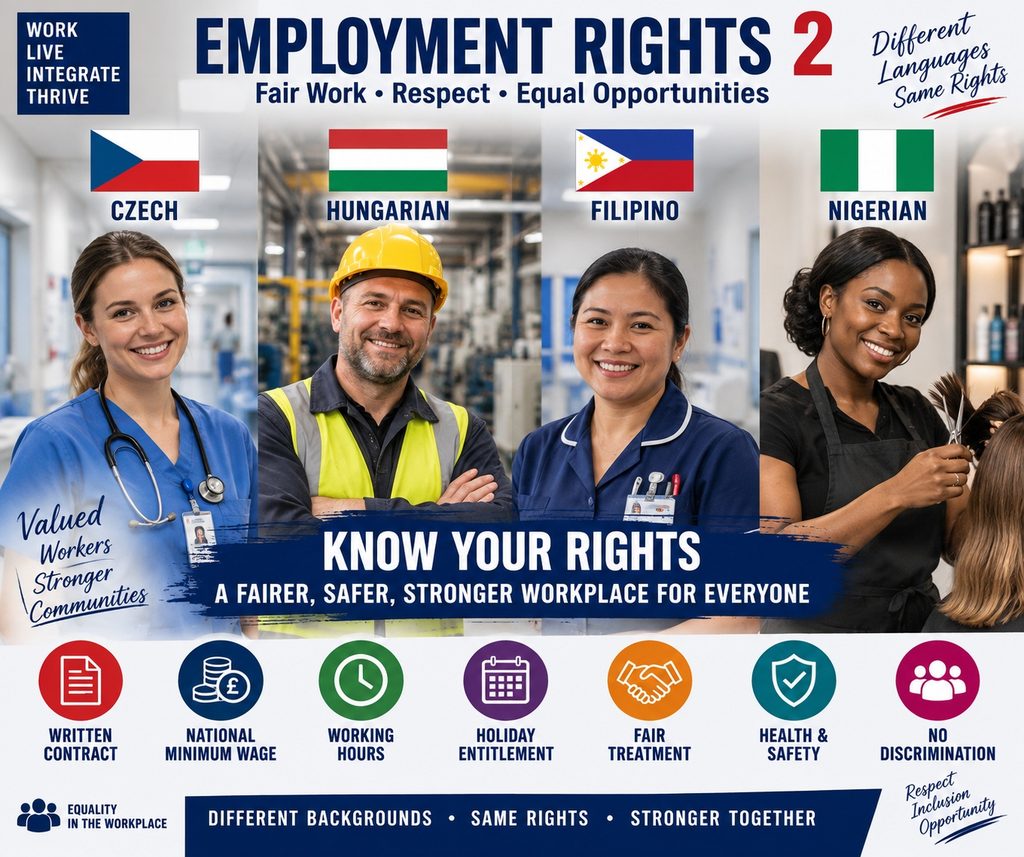
Employers must pay at least the applicable minimum wage. Workers should also receive an itemised payslip showing their gross pay, deductions such as Income Tax and National Insurance, and net pay.
If you believe you are being underpaid, keep your payslips, bank statements, employment contract, rotas and records of hours worked.
Working Hours, Breaks and Holidays
Most adult workers should not normally be required to work more than an average of 48 hours per week, although a worker can voluntarily agree to opt out of the 48-hour limit.
Workers are normally entitled to a 20-minute uninterrupted rest break when working more than six hours, as well as daily and weekly rest periods.
Most workers working five days a week are entitled to 5.6 weeks of paid annual leave per year, equivalent to 28 days. Bank holidays can be included within those 28 days.
Part-time employees and workers are also entitled to paid holiday, calculated proportionately.
Sick Leave and Statutory Sick Pay
There were important changes to Statutory Sick Pay in April 2026.
For sickness absences beginning on or after 6 April 2026, eligible employees can receive Statutory Sick Pay from the first full day of sickness. The previous three waiting days have been removed.
The previous minimum earnings threshold has also been removed. SSP is now calculated as 80% of average weekly earnings or £123.25 per week, whichever is lower.
This is particularly important for employees working limited or irregular hours who might previously have earned too little to qualify.
Discrimination at Work
An employer must not unlawfully discriminate against a worker because of a protected characteristic.
The Equality Act 2010 protects people in relation to age, disability, gender reassignment, marriage and civil partnership, pregnancy and maternity, race, religion or belief, sex and sexual orientation.
Protection can apply to recruitment, pay, promotion, training, working conditions, disciplinary action and dismissal.
Discrimination can include direct discrimination, indirect discrimination, harassment and victimisation.
Workers should keep evidence of discriminatory incidents, including emails, messages, letters, meeting notes and the names of witnesses.
Problems with Your Employer
If there is a serious problem at work, it is important to create a written record.
Depending on the circumstances, an employee may first raise the issue informally with their manager. If this does not resolve the problem, they may submit a formal grievance.
A grievance should clearly explain:
what happened, when it happened, who was involved, what evidence exists and what outcome the employee is requesting.
Employers should deal with grievances fairly and without unreasonable delay.
Disciplinary Action
An employer considering disciplinary action should normally investigate the allegations and give the employee an opportunity to respond.
The employee should be told what the allegation is and normally be provided with sufficient information to prepare for the disciplinary meeting.
In qualifying circumstances, employees have a statutory right to be accompanied at a disciplinary or grievance hearing by a trade union representative or workplace colleague.
Employees should also normally be given an opportunity to appeal against a disciplinary decision.
Dismissal and Unfair Dismissal
As of September 2026, employees generally still need two years of continuous employment to bring an ordinary unfair dismissal claim.
However, this is changing.
From 1 January 2027, the qualifying period for ordinary unfair dismissal protection is due to fall from two years to six months.
Importantly, some dismissals can already be automatically unfair without two years’ service, and discrimination claims do not require two years of employment.
For this reason, someone who has worked for an employer for less than two years should not automatically assume that they have no employment rights.
Redundancy
A genuine redundancy can arise where, for example, a business closes, a workplace closes or the employer’s requirement for employees to perform particular work reduces.
Employees with sufficient continuous service may qualify for statutory redundancy pay.
A redundancy process should be genuine and fair. Selection criteria should not unlawfully discriminate against employees.
A person should obtain advice if they believe that „redundancy” is being used simply as a reason to remove them following a dispute, complaint, pregnancy, disability issue or other protected situation.
ACAS and Employment Tribunal
Many employment disputes can ultimately be taken to an Employment Tribunal, including claims concerning discrimination, unfair dismissal, unlawful deductions from wages and certain other employment rights.
However, strict deadlines apply.
As of 13 September 2026, the normal time limit for most tribunal claims remains three months minus one day from the relevant event. Certain claims have different deadlines.
Importantly, from 1 October 2026, the time limit for most claims will increase to six months minus one day, where the time limit starts on or after that date.
Before submitting most Employment Tribunal claims, the claimant must first notify ACAS and obtain an Early Conciliation certificate. ACAS Early Conciliation can pause the tribunal limitation period while the process is taking place.
Submitting a grievance or an appeal to your employer does not itself stop the Employment Tribunal deadline. This is an extremely important point: an employee can still lose the right to bring a claim if they wait for the employer’s internal procedure to finish and allow the legal deadline to expire.
Protect Your Evidence
If you are experiencing problems at work, do not rely only on verbal conversations.
Keep copies of your employment contract, payslips, rotas, timesheets, emails, text messages, disciplinary letters, grievance correspondence, sickness records and notes of important meetings.
For significant conversations, make a dated written note recording who attended, what was discussed and what was decided.
Good evidence can make a substantial difference if the matter later proceeds to ACAS, settlement negotiations or an Employment Tribunal.
Need Support With an Employment Problem?
Employment disputes can develop quickly and strict legal deadlines may apply.
Equality for Community (EFORC) can provide practical support with employment-related matters, including understanding correspondence, preparing grievance and appeal letters, organising supporting evidence, assistance with ACAS Early Conciliation and administrative support with Employment Tribunal matters.
Where English is not your first language, we can also provide professional interpreting and certified translation support, helping you understand important employment documents and communicate clearly throughout the process.
Do not ignore letters from your employer and do not wait until an internal procedure has finished before checking whether a legal deadline applies to your case.
Dodaj komentarz